A Practical Way to Understand the Water Coming Into Your Home
Water has a funny way of becoming invisible in our daily routines. We turn on the faucet, fill a pot, take a shower, and hardly give it another thought. That changes pretty quickly when the glassware comes out cloudy, the showerhead develops crusty deposits, or the water starts tasting a little different.
Those signs can be frustrating, but they can also be useful clues. Instead of immediately buying the first filtration system you see, it’s worth taking a step back and figuring out what’s actually happening with your home’s water.
After all, you can’t choose a sensible treatment solution if you don’t know what you’re trying to fix.
Start With the Basics of Your Water Supply
The first thing to understand is where your water comes from. Municipal water and private well water can have very different characteristics, and even two homes on the same street may experience different issues.
The condition of household plumbing can matter, too. Older pipes, storage tanks, fixtures, and other components can influence water by the time it reaches the kitchen or bathroom faucet.
For homeowners using well water, regular testing is especially useful. A private well can be affected by changes in groundwater conditions, nearby land use, seasonal conditions, and other environmental factors.
This doesn’t mean you should be worried every time your water looks slightly different. It simply means that knowing the source gives you a better starting point.
Know Your Hardness and Mineral Levels
One of the first things many homeowners notice is mineral buildup.
Water naturally contains dissolved minerals, and calcium and magnesium are common contributors to hardness. The exact concentration can vary significantly depending on the water source.
Understanding the hardness and mineral levels in your water can help explain everyday problems such as spots on glassware, deposits around faucets, or soap that seems difficult to rinse away.
A water softener may be useful when hardness is significant, but testing first is still a smart move. There’s little benefit in treating a problem that isn’t actually present.
It’s also worth remembering that hard water isn’t the same thing as contaminated water. Hardness is primarily a mineral issue, while contamination involves other substances and potential health or environmental concerns.
Why Scale Builds Up Around the House
That white crust around a faucet isn’t just annoying because it looks messy.
When hard water is heated or allowed to evaporate, minerals can deposit on surfaces. Over time, these deposits may build up inside pipes, fixtures, water heaters, and appliances.
These scale-causing elements can be particularly troublesome in equipment that regularly heats water. A water heater, for instance, may accumulate mineral deposits on components exposed to hard water.
The amount of buildup depends on several factors, including mineral concentration, temperature, water usage, and equipment design.
Regular cleaning can help with surface deposits, but if the underlying water is consistently hard, cleaning alone won’t solve the root cause.
Testing Is Better Than Guessing
A water test can provide information that your eyes and nose simply can’t.
Basic testing may identify hardness, pH, iron, and other characteristics. Depending on your water source and concerns, more comprehensive testing may be appropriate.
This is especially important when something changes unexpectedly. If your water develops a new odor, unusual color, or different taste, it’s worth investigating instead of assuming the problem will disappear on its own.
Testing can also make equipment decisions much easier. Rather than buying a system because it worked for your neighbor, you can choose treatment based on your own results.
That’s a much more sensible way to spend money.
Your Home May Have Its Own Water Story
It’s easy to search online for the “best water filter” and assume one product will solve everything.
Real homes aren’t quite that simple.
The water quality issues specific to your home may be influenced by your water source, plumbing, household size, appliance use, and even how much water your family consumes.
For example, a household with a private well may focus on iron, sulfur odors, sediment, or bacteria testing. Another home connected to municipal water may be more concerned about chlorine taste, hardness, or aging plumbing.
The symptoms can overlap, but the solutions may be completely different.
That’s why a personalized approach usually makes more sense than copying someone else’s setup.
Pay Attention to Your Appliances
Your appliances can sometimes tell you more about your water than you realize.
If your dishwasher constantly leaves spots on glasses, if your shower fixtures need frequent descaling, or if your water heater seems to develop mineral buildup, those may be signs worth investigating.
Hard water can create additional cleaning work and may contribute to scale accumulation in water-using equipment.
But don’t assume every appliance problem is caused by water. Mechanical wear, detergent choice, temperature settings, and maintenance can all play a role.
Think of water quality as one possible piece of the puzzle.
Taste and Odor Matter, Too
Water doesn’t have to look unusual to seem unpleasant.
Some people notice chlorine taste in treated municipal water. Others may experience metallic, earthy, or sulfur-like odors, particularly with certain well-water conditions.
If taste is the main complaint, a suitable filtration system may improve the experience. Activated carbon, for example, is commonly used for certain taste and odor concerns.
Still, the right filter depends on what is causing the issue. A filter designed for chlorine won’t necessarily address minerals, iron, or other contaminants.
The label on the box isn’t a substitute for understanding the problem.
Think About Whole-Home and Drinking Water Separately
Not every water concern requires treatment throughout the entire house.
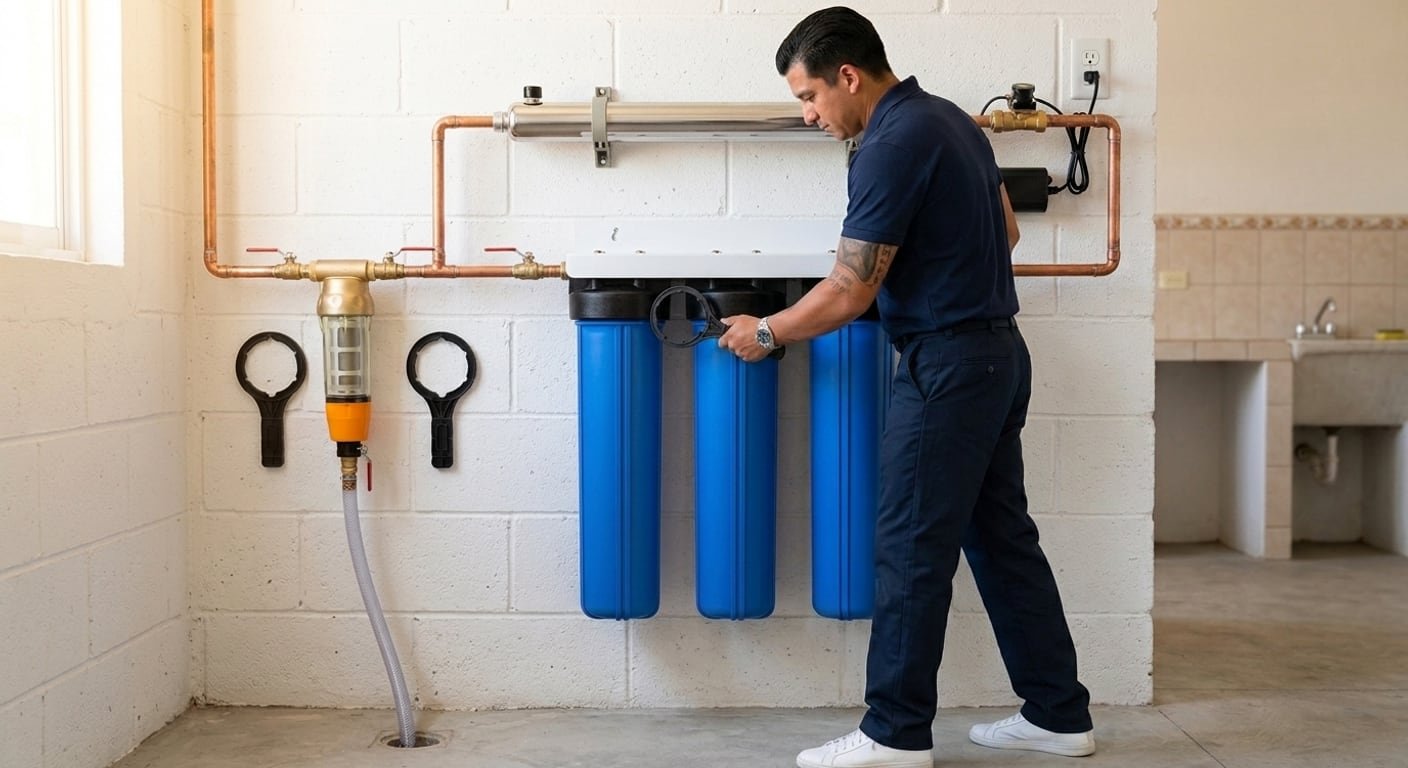
If the main concern involves drinking and cooking water, a point-of-use system in the kitchen may be practical. If hardness is affecting showers, laundry, fixtures, and appliances, whole-home treatment may make more sense.
Some households use both approaches. A softener can address hardness throughout the plumbing, while a dedicated drinking-water system provides additional treatment at the kitchen sink.
The right combination depends on the results of testing and how the household uses water.
Don’t Forget Maintenance
Even the right equipment won’t perform well forever without basic maintenance.
Filters need to be replaced. Softener systems may require salt or other supplies. Treatment media can eventually become exhausted. Components may also need inspection or servicing.
Keeping track of maintenance dates is surprisingly helpful. A simple reminder on your phone can prevent months of neglect.
It’s one of those boring household jobs that pays off later.
Better Water Starts With Better Information
Understanding your home’s water doesn’t have to become a complicated science project.
Start with the source. Look at the symptoms you’re noticing. Test when appropriate. Then choose treatment based on actual conditions.
Maybe the issue is hardness. Maybe it’s scale. Maybe the concern is taste, odor, sediment, or something that requires specialized testing. Whatever the answer turns out to be, knowing the cause gives you a much clearer path forward.
Good water treatment isn’t really about having the most expensive equipment or the longest list of features. It’s about solving the problem that actually exists.
Once that’s done, the benefits show up in ordinary little moments—cleaner-looking dishes, easier maintenance, better-tasting drinking water, and fewer deposits around the house.
Sometimes, the best water improvement is the one you barely notice because everything simply works the way it should.